
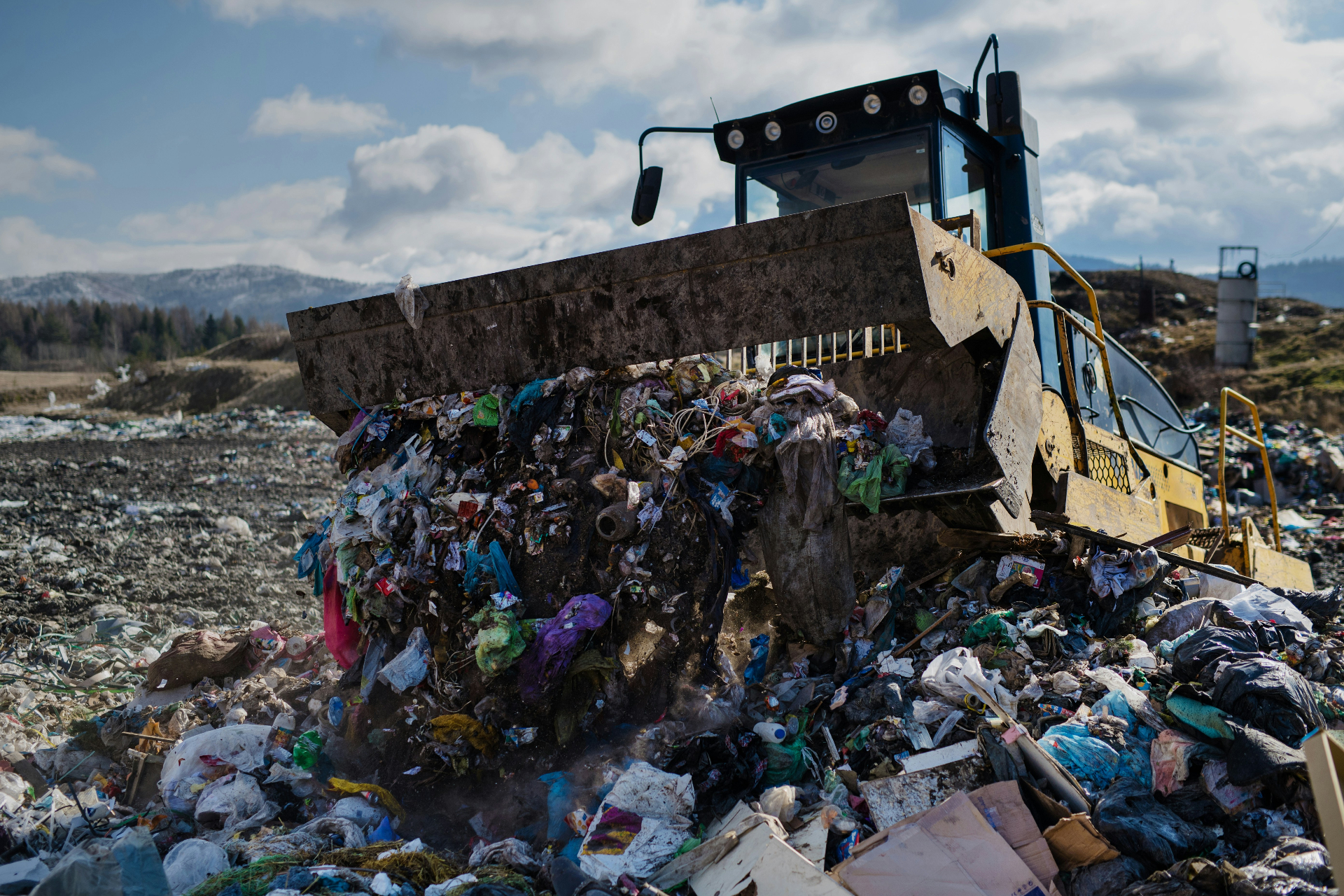
Someone else always paid for the waste. That just ended.
For decades the textile business worked because someone else paid for the waste. A garment was made, sold, worn a few times and thrown away, and the cost of whatever happened next fell on councils, charities and the countries that bought our cast-offs. That arrangement is being dismantled: the producer now pays for the end of life of what they sell, can no longer destroy what they fail to sell, and has to prove what a product is made of and how it comes back. The cost the industry has externalised for fifty years is moving onto its own balance sheet.
And it is moving onto a system that cannot yet absorb it. Textiles are made in enormous volume, worn briefly, and almost never turned back into new textiles. The EU throws away millions of tonnes of textiles a year, fibre-to-fibre recycling is almost non-existent, and virgin polyester is still cheaper than recycled fibre. So the bill is arriving exactly where there is the least capacity to deal with it, which is what turns a sustainability talking point into a commercial problem.
The supply chain
Textile value loop
Outer ring: textile value chain. Purple: virgin fibre in. Inner arcs: loops returning material upstream, coloured by value retained. Clay: cascaded but still in use. Red: value lost as microplastics, waste, export or disposal.
R-ladder · value kept in the loop
- R0–R2Smarter use & design cuts virgin inflowRefuse, rethink, reduce
- R3–R7Extend lifespanReuse, repair, refurbish, repurpose
- R8RecycleMechanical & chemical recycling
- R9Recover energyEnergy recovery
Other channels · outside the R-ladder
- virginVirgin inputVirgin fibre, fossil polyester and cotton
- cascadeCascadeDowncycled to insulation and rags
- lossValue destroyedLandfill, incineration & emissions
- chainThe chainPrimary value chain path
The problem from where you sit
CEO, CFO or owner
The cost you used to externalise is landing on your balance sheet.
For decades the price of a garment ended at the till, and whatever happened to it afterwards was someone else's bill. That is over. A producer fee now attaches to every unit you place on the market, the stock you cannot sell can no longer be written off through destruction, and what even counts as a sellable product is being defined by ecodesign rules you do not set. The volume your margins quietly depend on is becoming the volume you are charged and constrained on. The question is how much of your current range and run-rate converts into cost now that the destruction ban applies and as the 2028 producer fees approach.
Sourcing, design or sustainability manager
Fibre choice, design specification and reporting now decide each other.
Until now, fibre choice, design specification and reporting sat in different lanes on different desks. The new rules tie them together, and that link is where the exposure now sits. The blend chosen in design decides whether the product is recyclable, which sets the producer fee the business pays. The recycled material that sourcing is asked to find has to actually exist at the volume and price the targets assume, or the recycled-content claim collapses under scrutiny. The data that sustainability reports stops being an annual return and becomes a product passport that has to be true at the point of sale. You can no longer fix your own lane and pass the problem on, because your decision is now the input to someone else's compliance.
Design studio or shop floor
The waste you have always been able to see is about to have a price tag.
You are the one who notices it first: the seam built to fail, the blend no recycler will take, the over-order heading for a skip. For years those were quiet inefficiencies that never reached a report, and raising them changed nothing. Under the new rules each one becomes measured cost and compliance exposure, tied to a specific product and a specific fee. The difficulty is structural: the people choosing fibres, formats and order volumes are usually not the ones who see the waste, and by the time it is visible the product is made. What you notice on the line is now commercially material, and it is only worth anything if it reaches those decisions early, while the product can still change.
A recycled line is not a circular business
None of this is solved by switching to recycled fibre and calling the result circular. The pressures arriving are separate things with separate owners and timelines: a recycled line still pays the producer fee on its volume, and still cannot destroy what it does not sell. Treating them as one problem is how a brand markets a recycled capsule while the volume and the end-of-life cost behind it go unaddressed. So the first question is not which claim to make. It is which pressure binds first for you.
The textile rules, and when they start to bite
The regulatory force on textiles lands in three connected instruments. The revised Waste Framework Directive makes separate collection mandatory and introduces extended producer responsibility, so brands fund the collection, sorting, reuse and recycling of what they place on the market, with fees modulated by how circular each product is. The Ecodesign for Sustainable Products Regulation makes textiles a priority group, brings a digital product passport, and bans the destruction of unsold clothing and footwear. Together they price the full life of a garment into the business that sells it.
1 Jan 2025
Waste Framework Directive
Separate textile collection mandatory across the EU
In forceOct 2025
Waste Framework Directive
Revised WFD in force, mandatory textile EPR introduced
In force19 Jul 2026
ESPR
Destruction ban on unsold clothing and footwear, large firms
In force2027
ESPR
ESPR delegated act for textiles, digital product passport expected
Upcoming2028
EPR
Textile EPR schemes operational, fees modulated by circularity
Upcoming2030
ESPR
Destruction ban extends to medium-sized firms
Upcoming
For a brand or retailer this turns the back end of the business into a cost it owns. The clothes it sells now carry a fee for their eventual collection and recycling, the stock it cannot sell can no longer be quietly destroyed, and the product it designs has to be declared and built to be recovered. The decision moves upstream to design and volume, because that is where the producer fee and the recyclability are set.
The cost of overproduction comes home
The second force is structural, and it is the bill for a volume model arriving with nowhere cheap to send it. The industry's economics have rested on making and selling far more than is worn, and on the low cost of disposing of the surplus, much of it by export. The revised waste rules now require textiles to be sorted before export and tighten the controls on shipping textile waste outside the EU, while producer responsibility puts the cost of end of life onto the brand.
At the same time the recycling capacity to absorb that material barely exists, because fibre-to-fibre recycling is technically hard and economically marginal against cheap virgin polyester. Behind that sits a financing problem. Capital for circular textiles is fragmented and aimed at one-off projects, while building sorting and recycling at scale needs investment across the whole chain and the whole lifecycle, and it will not move without offtake certainty, the assurance through long-term purchasing agreements or a recycled-content requirement that recycled material will actually be bought. The structural pressure is the collision between a high-volume model whose waste can no longer be cheaply exported and a recycling system that has neither the capacity nor, yet, the financing to receive it.
The waste the system cannot take
Volume is rising and the cheap exit is closing, while the system that should absorb the waste has no capacity, no economics and no finance behind it. Nothing absorbs the difference, so producer responsibility leaves it with the brand.
Waste rising, cheap exit closing
High-volume model
The industry makes and sells far more clothing than is ever worn.
Export route closing
New sorting rules and tighter export controls close the cheap disposal route, and producer responsibility puts the end-of-life cost on the brand.
No way to absorb it
Recycling near zero
Fibre-to-fibre recycling capacity barely exists at commercial scale.
Economics upside down
Virgin polyester is still cheaper than recycled fibre, so the market pulls the wrong way.
Finance missing
Capital is fragmented and there is no offtake certainty, so investors will not build the sorting and recycling capacity the chain needs.
The brand pays the cost
Volumes keep climbing while the recycling system stays unable to absorb them, and producer responsibility hands the resulting cost straight to the brand.
For a brand this is the pressure with no deadline and no quick fix. The cost of overproduction is arriving at a system not built to absorb it cheaply, so the cheapest response is to produce less that ends up as waste, and to move before the squeeze tightens rather than after.
How circular each market really is
These are economy-wide circularity rates from Eurostat and the Circularity Gap Report, not textile recycling rates.
European Union
12.2% circular material use, Eurostat 2024
The EU is closing the throwaway model from several sides at once, and the rules reach any brand selling into the market regardless of where it is based or made.
- Separate collection of textiles: mandatory across the EU since 1 January 2025
- Textile Extended Producer Responsibility (EPR), revised Waste Framework Directive: national schemes operational by 2028, fees set by how circular a product is
- Digital product passport and ecodesign, Ecodesign for Sustainable Products Regulation (ESPR): delegated act for textiles expected 2027
- Destruction ban on unsold clothing and footwear, Ecodesign for Sustainable Products Regulation (ESPR): large firms 19 July 2026, medium 2030
- Waste Shipment Regulation: sorting before export and tighter controls separating reusable textiles from textile waste
International
6.9% global circularity, Circularity Gap Report 2026
Outside the EU the rules are uneven but spreading. A brand built to the EU specification will already clear most of them.
- France: textile Extended Producer Responsibility (EPR) since 2007, run through the Refashion producer organisation
- Other EU movers: the Netherlands since 2023, Latvia since 2024
- California: Responsible Textile Recovery Act, SB 707, signed September 2024, a US state textile Extended Producer Responsibility (EPR) law; producers must join a producer responsibility organisation by July 2026, with the programme building toward 2028
- Direction of travel: textile rules are tightening rather than relaxing, with the EU framework the practical global benchmark
Netherlands
32.7% circular material use, Eurostat 2024
Holding the EU's highest circular material use rate, the Netherlands moved ahead of the EU mandate, so the question here is capacity and finance rather than intent.
- UPV Textiel: extended producer responsibility in force since 1 July 2023, run through Stichting UPV Textiel (set up by Modint and INretail), overseen by the ILT
- 2025 targets: 50% of textiles placed on the market prepared for reuse or recycling, of which at least 20% reuse, at least 10% reused within the Netherlands, and at least 25% of recycling fibre-to-fibre
- 2030 targets: rising to 75% prepared for reuse or recycling, at least 25% reuse, at least 15% reused domestically, and at least 33% fibre-to-fibre
- Open question: whether high-quality recycling capacity, and the staged financing behind it that bodies such as Invest-NL are working on, can be built fast enough
Ireland
2.0% circular material use, Eurostat 2024
Sitting near the bottom of the EU for circular material use, Ireland comes at textiles as a high-consuming market with a strong charity base but little sorting and recycling infrastructure.
- National Policy Statement and Roadmap on Circular Textiles, 2026 to 2028: launched 2 April 2026
- Textile Extended Producer Responsibility (EPR) scheme: to be established by April 2028, shifting collection and end-of-life cost onto producers and retailers
- Ireland throws away over 110,000 tonnes of post-consumer textiles a year
- 2030 commitment: full enhanced separate textile collection nationwide, with broader responsible disposal and donation options
Where does this leave you?
Five statements about the rules and pressures now hitting textiles. Tick the ones that already hold for your brand. The gaps carry the cost and set the order of the work.
- 1. We know our exposure to textile producer-responsibility fees and how product design changes them.
- 2. We can account for what happens to our unsold stock, and we are ready for the destruction ban.
- 3. We know which of our products are recyclable and which rely on hard-to-recycle blends.
- 4. We have a view of our overproduction and the volume that goes unsold or unworn.
- 5. We are building or supporting collection, reuse and recycling routes for what we sell.
Answer all five statements to see your readout.