
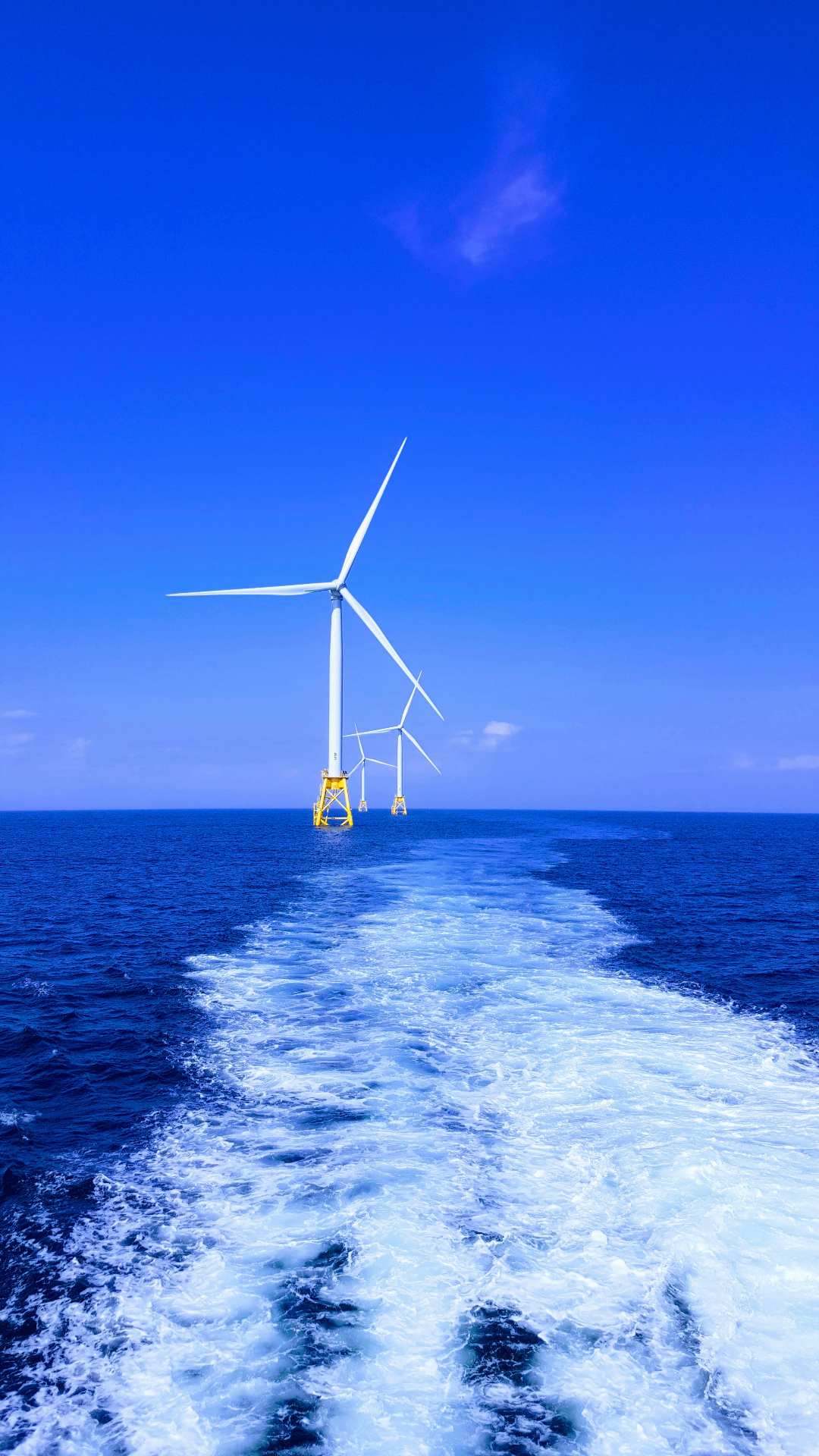
Offshore wind is a clean-energy story built on a very large material bill.
Offshore wind is usually told as a clean-energy success story, and in climate terms it is. Physically it is also one of the largest material build-outs Europe has ever attempted: steel towers, concrete and steel foundations, copper cables, composite blades, rare-earth magnets, coatings, vessels, ports and installation infrastructure, all deployed at sea under harsh operating conditions and long investment timelines. That material reality used to sit behind the energy story. It cannot stay there.
The Netherlands and the North Sea are scaling offshore wind at the same time as the first generation of turbines begins to reach end of life, critical-material dependencies become politically exposed, and circularity starts appearing inside tenders rather than sustainability reports. Building renewable capacity fast is only half the question. The other half is whether the sector can build, maintain, upgrade, repower and decommission that capacity without creating the next materials problem, and that is decided before the turbine enters the water.
The supply chain
Offshore Wind value loop
The outer ring is the offshore-wind value chain. Purple shows virgin inputs entering the system, with rare-earth magnets and composites distinguished because they carry the highest supply and recovery risk. The inner arcs are circular loops that return value to an earlier stage, coloured by how much is retained. The clay arrow is composite that cascades down but stays in use, and the red arrows are blades, magnets and critical materials lost when recovery is not organised in from the start.
R-ladder · value kept in the loop
- R0–R2Smarter use & design cuts virgin inflowRefuse, rethink, reduce
- R3–R7Extend lifespanReuse, repair, refurbish, repurpose
- R8RecycleMechanical & chemical recycling
- R9Recover energyEnergy recovery
Other channels · outside the R-ladder
- virginVirgin inputVirgin steel, copper, concrete and aggregates; Rare-earth magnets (Nd, Pr, Dy, Tb) and composites
- cascadeCascadeDowncycled composite to cement and fillers
- lossValue destroyedLandfill, incineration & emissions
- chainThe chainPrimary value chain path
The problem from where you sit
Developer, asset owner or CFO
End-of-life has moved out of the decommissioning provision and into today's tender score.
For decades the materials in a turbine were the OEM's problem and the disposal was a line in the decommissioning provision. That is changing. Circularity is arriving as tender criteria, supply-chain exposure and end-of-life liability at the same time, not as a future sustainability line. Developers who treat turbines as long-life material assets from day one, with the documentation and recovery rights to match, set the benchmark others have to meet. Those who wait inherit a decommissioning bill and a weaker tender position. The variable you control is whether you design and contract to recoverability ahead of the 2030 date, or pay for it under one.
Procurement, tender or sustainability lead
Three calls that once sat apart are now made together.
Procurement, sustainability and tender response used to sit on different desks. The new rules make each one depend on the other two. Tender criteria now reward circular design and end-of-life planning, so what procurement specifies decides the win as well as the cost. Design-for-disassembly requirements, material documentation, and ownership and recovery rights have to be written into contracts upfront, because by decommissioning the recoverable value is already determined. The reporting your sustainability function used to produce annually becomes the data the tender, the digital product passport and the recovery chain all rely on. Fixing your own lane is no longer enough, because the next desk depends on what you decide.
Engineering, ports or operations
What you see in the wind, on the deck and at the quayside is the data the rest of the chain is missing.
You are the ones who decide whether a blade can be cleanly removed, whether a magnet can be recovered, whether a foundation can be reused, and whether the inspection and failure data exists to make repowering a real option. For years much of that operational knowledge stayed in spreadsheets and tacit memory. Under the new rules and tender criteria it becomes the input that decides whether circular intentions turn into real decisions. The difficulty is structural: the people specifying bonding, materials and documentation are usually not the ones who see the wear and the failure patterns. What you capture and share early is now commercially material, and it is only worth anything if it reaches design, procurement and tender decisions while the project can still change.
Why a blade-recycling deal leaves the bill where it was
None of this is solved by announcing a blade-recycling partnership and calling the sector circular. The pressures arriving are separate things with separate owners and timelines: a blade route does not handle magnets, a magnet recovery pilot does not change tender scores, and neither addresses the asset data needed to know what is installed and what can come back. Treating them as one problem is how a developer launches a recycling story while the tender, the magnet exposure and the decommissioning bill go unaddressed. By the time the turbine is being removed, the key decisions have already been made: material choice, bonding, documentation, ownership of parts, recycling contracts and port logistics. So the question to settle first is which pressure binds soonest for the project.
The wind and materials rules, and when they bite
The regulatory force on offshore wind lands in three connected places. The European wind industry's own commitment closes the cheapest disposal route for blades. The Ecodesign for Sustainable Products Regulation is preparing component-level rules and a digital product passport that will reach wind components. And the Critical Raw Materials Act sets EU-level targets for recycling and domestic supply of the rare-earth elements that direct-drive turbines depend on. Together they turn what the sector does with its materials from a sustainability promise into a procurement, tender and supply-chain variable.
23 May 2024
CRMA
Critical Raw Materials Act enters into force, including a 25% recycling benchmark for strategic raw materials by 2030
In force1 Jan 2026
WindEurope commitment
WindEurope members' commitment not to landfill decommissioned blades applies
In force2026–2030
WindEurope projection
Around 14,000 European blades forecast for dismantling, generating 40,000 to 60,000 t of blade waste
Upcoming2027
ESPR
ESPR delegated acts on iron, steel and aluminium expected to reach turbine materials
Upcoming2030
CRMA
CRMA targets bind: 10% extraction, 40% processing and 25% recycling of strategic raw materials within the EU
Upcoming
For a developer or supplier this turns end-of-life from a decommissioning provision into a present-day tender variable. The blade you install now cannot be landfilled when it comes down, the magnets you specify are tied to a supply system the EU is trying to reshore and recycle, and the product passport coming under ESPR will require data the sector does not yet routinely keep. The decision moves upstream to design, contract and tender, because that is the only point at which recoverability can still be built in.
The cost of treating end-of-life as someone else's problem
The second force is structural, and it is the bill for a build-out model arriving on a system that was not designed to take the materials back. Offshore-wind tenders are pricing circularity into the score; first-generation turbines are coming down across the North Sea; and the rare-earth magnets that make direct-drive turbines viable connect the sector to a concentrated supply chain Europe does not control.
At the same time the recovery system that should absorb all of this barely exists. Fibre and resin recovery from composite blades is technically hard and economically marginal. Magnet recovery has almost no commercial chain in Europe yet. And the asset data needed to know what is installed, where, in what condition and under whose recovery rights is rarely kept in a form anyone downstream can use. Behind that sits the chain itself: developers, OEMs, ports, recyclers, insurers and public authorities each control one part of the loop, and without alignment between them the cost of inaction is the one that gets paid.
Recovery required, recovery chain missing
Tender and material pressure is arriving on a sector whose recovery chain is the part of the system least built and least financed. The two run on different timelines, and the shortfall becomes the developer's cost.
Recovery becoming non-optional
Circular tender criteria
Offshore-wind tenders increasingly score design for disassembly, end-of-life planning and recycled content, so circularity sets win rates rather than reporting lines.
Critical-material exposure
Rare-earth magnets in direct-drive turbines tie the sector to a concentrated supply chain the EU is now trying to reshore and recycle under the CRMA.
Blade landfill closed
The European wind industry's 2026 landfill ban closes the cheap disposal route for decommissioned blades just as volumes rise.
No recovery chain at scale
Blade recycling thin
Composite recovery routes exist in pilots but are technically hard and economically marginal at sector scale.
No magnet-recovery industry
Europe has almost no commercial magnet recovery, refurbishment or remanufacturing capacity to take rare earths back into circulation.
Asset data missing
What is installed, where, in what condition and under whose recovery rights is rarely captured in a form downstream actors can act on.
The developer carries the bill
Recovery requirements are rising faster than the recovery chain is being built. Tender criteria and decommissioning liability leave the difference with the developer.
For a developer this pressure arrives without a fixed date and without a shortcut. The recovery requirements are tightening while the chain that should absorb them is still being built, so the cheapest response is to design and contract to recoverability now, and to coordinate the chain that will execute it, before the squeeze tightens rather than after.
How circular each market really is
These are economy-wide circularity rates from Eurostat and the Circularity Gap Report, not offshore-wind recycling rates.
European Union
12.2% circular material use, Eurostat 2024
The EU is treating offshore wind as part of its industrial strategy as well as its climate one, and the rules now reach the materials behind the turbine as well as the energy in front of it.
- Critical Raw Materials Act (Regulation (EU) 2024/1252): 25% recycling, 40% processing and 10% extraction benchmarks for strategic raw materials within the EU by 2030
- Ecodesign for Sustainable Products Regulation (ESPR, 2024/1781): energy-related products in scope, with delegated acts on iron and steel expected from late 2026 and on aluminium in 2027, reaching turbine materials rather than turbines themselves
- European wind industry's commitment to ban landfilling of decommissioned blades from 1 January 2026
- Tender practice: circularity criteria scored in offshore-wind tenders in the Netherlands, Denmark, Germany and increasingly the UK
International
6.9% global circularity, Circularity Gap Report 2026
Outside the EU the rules are uneven but the supply and decommissioning questions are the same, and a developer or supplier built to the strictest standard carries that advantage into every market.
- United Kingdom: Crown Estate and ScotWind leasing rounds increasingly reference circular and supply-chain criteria; Offshore Wind Industrial Growth Plan sets domestic content ambitions
- United States: Inflation Reduction Act and state procurement push domestic content for offshore wind, including magnets and rare earths
- Asia-Pacific: large dismantling and repowering wave forming in China, with Japan and Korea building offshore-wind supply chains from scratch
- Rules on circular design and critical materials in offshore wind are tightening in every market listed above
Netherlands
32.7% circular material use, Eurostat 2024
The Dutch lead the EU on circular material use and run an early test bed for circular offshore-wind tendering in the North Sea, so the question here is execution rather than intent.
- Offshore-wind pathway revised to roughly 30–40 GW by 2040, down from earlier 50 GW expectations as electrification and project economics moved more slowly than expected
- RVO and Rijkswaterstaat tenders score circularity and ecology criteria alongside price, with several Dutch sites awarded on circular and system-integration grounds
- Active programmes on blade recycling, magnet recovery and circular supply-chain coordination (including the BlueCity offshore-wind track)
- Open question: whether port, recycling and magnet-recovery capacity can be built fast enough to absorb the first wave of decommissioning and repowering
Ireland
2.0% circular material use, Eurostat 2024
Ireland, a low performer on circular material use within the EU, comes at offshore wind from the build-out side, with a large pipeline relative to its industrial base.
- Target of 5 GW offshore wind by 2030, with far more in the Celtic Sea and Atlantic beyond, set under the Climate Action Plan and Future Framework for Offshore Renewable Energy
- Binding constraint is port capacity: Irish ports are not yet equipped to assemble, install and service projects at this scale
- Marine area more than seven times Ireland's landmass, so the opportunity is a change of scale rather than an increment
- Circular questions land first at supply-chain entry and at port: what is sourced where, and what comes back through which port at end of life
Where does this leave you?
Five statements about the rules and pressures now hitting offshore wind. Decide which ones your project can already stand behind. The ones it cannot are where to start.
- 1. We know how circular criteria are scored in the tenders we compete in, and how that changes our design and supplier choices.
- 2. Our contracts and design specifications include design-for-disassembly, material documentation and recovery rights.
- 3. We have a credible end-of-life route for blades that does not rely on landfill or indefinite storage.
- 4. We know our exposure to rare-earth and other critical materials, and we have a view on recovery and substitution.
- 5. We capture asset, condition and material data in a form that supports lifetime extension, repowering and recovery decisions.
Answer all five statements to see your readout.