
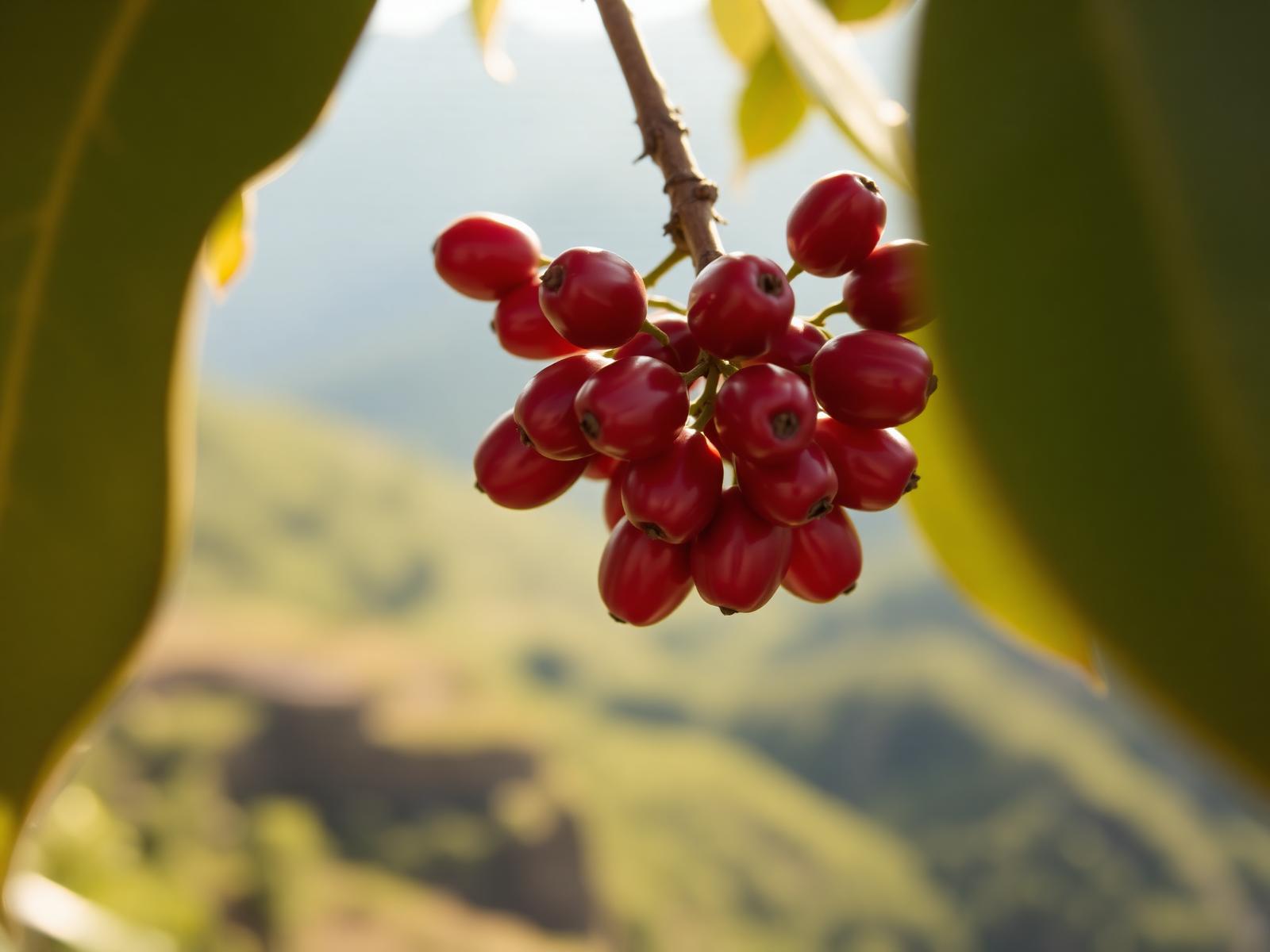
By weight, coffee is mostly the part nobody drinks.
Coffee is an international product in the most literal sense. Every cup traces back to specific plants on specific farms, most of them smallholdings, in a narrow band of tropical origins thousands of miles from the people who drink it. It is also, by weight, mostly the part nobody drinks. Both of those facts used to sit in the background of the business. They are now moving to the front, because what a coffee company knows about its origins, and what happens to everything that is not the bean, decide whether it can trade.
For years circularity in coffee was a story told on a bag: shade-grown, single-origin, a project at source. It is becoming something harder. Traceability is becoming a legal requirement for market access, and the byproduct streams that were a disposal cost are becoming either a liability or a revenue line. For coffee, unlike a domestic industry, the decisions that matter are made at origin rather than at the roastery.
The supply chain
Coffee value loop
The outer ring is the coffee value chain, from smallholder plots to the spent grounds left after the cup. Purple shows new land and inputs entering at origin. The inner arcs are circular loops that turn byproducts at origin and at consumption into value, coloured by how much they retain. The red arrows are the streams currently lost as methane, landfill or pollution.
R-ladder · value kept in the loop
- R0–R2Smarter use & design cuts virgin inflowRefuse, rethink, reduce
- R3–R7Extend lifespanReuse, repair, refurbish, repurpose
- R8RecycleMechanical & chemical recycling
- R9Recover energyEnergy recovery
Other channels · outside the R-ladder
- virginVirgin inputLand, often under deforestation pressure
- lossValue destroyedLandfill, incineration & emissions
- chainThe chainPrimary value chain path
The problem from where you sit
CEO, CFO or owner
Market access is now the question.
EUDR is a market-access deadline, not a reporting task. The capital question shifts from the cost of compliance to the cost of losing market access and losing supply. Plot-level traceability, byproduct valorisation and investment at origin are risk reduction, and they belong in the risk budget. The variable is whether you build readiness before the deadline or pay for it under one, and whether the relationships you depend on at origin are strong enough to hold when climate and price move at the same time.
Sustainability or sourcing manager
Traceability is no longer a parallel CSR track.
Until now origin transparency lived in the sustainability report and influenced procurement only at the margins. Under EUDR it increasingly decides whether coffee can be sold in Europe at all, which means the data has to be operational, not narrative. The internal conversation lands hardest when it shows up in sourcing and procurement decisions rather than in the annual cycle. The work is to wire the same plot-level data into compliance, supply security and the byproduct case at the same time, so one build serves three goals.
Green coffee buyer or trader
You sit on the seam where EUDR evidence holds or breaks.
Many smallholder lots mix at the washing station and the exporter long before they reach the roaster, and that is where the proof either survives or is lost. The leverage is in how supply is structured and documented at origin and in who owns the resulting data. Buyers who can prove provenance back to the plot, in a form the farmer also benefits from, are the ones roasters will keep as the deadline approaches.
The trap is treating it as a data scramble
The common failure in coffee is to treat the deadline as a one-off collection task: gather the geolocation points, file the statements, move on. That misreads what is happening. EUDR compliance, supply resilience and byproduct value are different goals, and each needs its own data, partners and investment. Collect plot coordinates once to clear an audit and you may have done nothing for supply security or for the value sitting in your waste streams. Chase a byproduct revenue line and you may still fail the audit. So the first question is which pressure binds first for you.
The pressure with a deadline: EUDR
The first force reshaping coffee is regulatory, and it has a date. The EU Deforestation Regulation requires that coffee placed on or exported from the EU market be proven free of deforestation and traceable to the specific plot of land where it grew, backed by geolocation coordinates and a due diligence statement. After two postponements it applies from 30 December 2026 for large and medium operators and 30 June 2027 for micro and small ones, with penalties that can reach 4% of an operator's EU turnover. The deadline has moved more than once, but the substance of the obligation has not changed.
Jun 2023
EUDR
EUDR enters into force, coffee listed as an in-scope commodity
In forceDec 2025
EUDR
Targeted revision adopted: simplification and second postponement
In force30 Dec 2026
EUDR
EUDR applies to large and medium operators and traders
Upcoming30 Jun 2027
EUDR
EUDR applies to micro and small operators and traders
Upcoming
For a roaster or brand this turns sourcing into a market-access question. Plot-level traceability stops being a premium feature for a specialty line and becomes the price of selling coffee in Europe at all. The decision moves upstream, into how lots are aggregated, what is recorded at origin and who holds the proof.
The pressure without a date: supply and the wasted part
The second force is slower but no less serious. Coffee is highly exposed to climate, the land suitable for arabica is under growing pressure, production concentrates in a handful of origins, and prices have swung sharply in recent years. Securing reliable, compliant supply now depends on relationships: you have to know your farms and keep them economically viable and producing through climate stress.
At the same time the part of the plant nobody drinks (pulp, mucilage, husk, parchment, silverskin and spent grounds) is mostly still treated as a disposal cost, left to break down in the open at origin or sent to landfill at the point of consumption. That is the structural gap. A company that knows its origins well enough to satisfy a regulator is also a company better placed to secure supply and to turn its byproducts into value, and the three needs increasingly point at the same investment.
Risk at origin, value downstream
Compliance, climate and byproduct disposal all land on the same farms, while the value built on their coffee stays downstream. Nothing in the chain moves that cost back to where the margin is.
Pressure landing at origin
EUDR evidence
Every plot behind a shipment must be geolocated, legal and deforestation-free, with the evidence held and produced on demand.
Climate and supply risk
Arabica's climate window is narrowing and a handful of origins carry the bulk of global supply, so any disruption is felt across the chain.
Byproduct disposal
Pulp, husk and mucilage are mostly left to break down at origin, releasing methane and leaching into waterways.
Value stays downstream
Aggregation hides origin
Lots from many smallholder plots mix at washing stations and exporters long before the roaster sees them, so plot-level proof is the part of the chain that does not yet exist.
Margin concentrates after origin
Most of the price a consumer pays is captured at and after roasting, far from where the compliance cost and the climate risk actually sit.
Data owned by the buyer
When traceability is built only to satisfy a regulator, the proof is held by the buyer rather than the farmer, so the cost is pushed back to origin and the value stays downstream.
Traceability as an asset farmers own
Compliance cost falling on origin while value stays downstream is not a stable arrangement. The fix is traceability designed so the proof becomes the farmer's asset rather than only the buyer's defence. That is also what makes supply resilience and byproduct value into business cases.
For a coffee business this is the pressure with no single deadline. Climate, supply and byproduct disposal are arriving together, and the cheapest response is to build the relationships and the data once, in a form that serves compliance and supply security at the same time.
How circular each market really is
The circularity percentages below are economy-wide indicators, not coffee-specific recycling rates.
European Union
12.2% circular material use, Eurostat 2024
The EU is the regulator that sets the global benchmark for coffee, because anything sold into the bloc has to clear EUDR regardless of where it is roasted or grown.
- EU Deforestation Regulation (EUDR), Regulation (EU) 2023/1115: coffee an in-scope commodity, plot-level geolocation and due diligence required
- Application dates after the December 2025 targeted revision: 30 December 2026 for large and medium operators, 30 June 2027 for micro and small ones
- Penalties: up to 4% of an operator's EU turnover, plus exclusion from public procurement and seizure of non-compliant goods
- The December 2025 revision simplified and postponed the regulation but left the substantive obligation unchanged.
International
6.9% global circularity, Circularity Gap Report 2026
Outside the EU the picture is uneven: producing countries are building national traceability and origin protection, while consuming markets watch the EU model and adjust.
- Brazil, Vietnam, Colombia, Ethiopia, Honduras and Indonesia together account for the bulk of global supply.
- National schemes: Brazil and Colombia have invested in plot-level data and producer organisations that can carry EUDR evidence at scale
- Smallholder exposure: in most origins coffee is grown largely on smallholdings, where the cost of compliance lands hardest
- Downstream markets: the UK, US and Japan watch the EU regime; voluntary standards (Rainforest Alliance, Fairtrade, organic) are being aligned to EUDR data needs
Netherlands
32.7% circular material use, Eurostat 2024
The Netherlands is the EU's main coffee gateway, with Amsterdam and Rotterdam handling a significant share of green coffee into the bloc, so the operational pressure of EUDR is concentrated here.
- Port of Amsterdam: a major green coffee hub, with large warehousing and trading clusters
- Dutch roasters and traders are early movers on EUDR readiness, plot-level traceability platforms and origin partnerships
- National circular economy strategy targets a fully circular economy by 2050, with agri-food a priority chain
- Open question: how aggregation at the port is reconciled with plot-level evidence without pushing the cost back onto smallholders
Ireland
2.0% circular material use, Eurostat 2024
Ireland is a small but high-value consuming market with a strong specialty scene and a growing roasting base, so the EUDR question lands on roasters and importers rather than on production.
- Specialty roasting sector concentrated in Dublin, Cork and Galway, sourcing through European green coffee importers
- EUDR applies in full to Irish operators and traders on the same dates as the rest of the EU
- National circular economy strategy and Circular Economy Act 2022 frame the wider policy direction, with agri-food a priority area
- Café and hospitality waste streams, including spent grounds, are largely uncollected for valorisation today
Where does this leave you?
Five statements about the rules and pressures now hitting coffee. Work through them and note which ones you can back up. Each gap is a place where cost lands and where work should begin.
- 1. We know which of our coffee volumes are exposed to EUDR and on which application date.
- 2. We can trace our supply back to the plot or the cooperative for the share of volume that matters.
- 3. We know which origins are climate-exposed and have a plan if one or more falls short.
- 4. We have a view of the byproducts our chain generates at origin and at consumption.
- 5. We know who owns the traceability data we collect and what value the farmer gets from it.
Answer all five statements to see your readout.
Where Circular Intelligence works
Circular Intelligence works at the point where coffee sourcing has to become an operational decision rather than a marketing line. The questions are EUDR traceability that holds back to origin, byproduct streams run as business cases rather than disposal lines, and a sourcing strategy that accounts for climate and supply exposure. The test is whether the claim still holds when someone follows it back to the farm.